green, indigo and foodie drinks

162040 116771501728270 8152700 n green, indigo and foodie drinksYou may have heard of Green Drinks. It started in England years back and now is in over 600 cities globally. It’s an event where people in the ‘green scene’ (e.g. academics, entrepreneurs, ngo or government workers) can get together to meet each other in a casual environment.

We host one here in Edmonton and it goes really, really well. We just had one on January 18th and it went super well.

41597 129924477041296 9557 n green, indigo and foodie drinksLast year, we hosted an event called Indigo Drinks – which was about bringing together people in the Edmonton holistic health scene. We got about 50 people out and it was a huge success. In the end, the group hosting it needed to step back so none have happened since then – but I think it will be coming back.

Well, here’s another event – for folks passionate about local food. Some words from their facebook event . . .

161958 163586817020845 3045149 n green, indigo and foodie drinks“Foodies” aren’t just those who care about the best dish – they care about expanding access to healthy food, supporting farmers and animal welfare too.

Come out to the next casual get together for Toronto’s food movement, this time at the Gladstone! The Gladstone serves local, sustainable food certified by Local Food Plus and does much more to support local farmers and the environment: http://www.gladstonehotel.com/about/philosophy/food-philosophy
The new Gladstone is celebrating its fifth anniversary, but this bar’s been rockin since the 1890s.

This month we’ll again be highlighting a local non-profit and business. We’ve confirmed the business will be http://bufco.ca/

Event is free, but we encourage you to make a $10 donation if you’re able to help us cover costs of organizing events and pushing good food policy forward at City Hall.

I chatted with Foodie Drinks founder Darcy Higgins and asked him some questions.

How did this all get started?

There is a lot of energy in Toronto’s food movement. I wanted a casual opportunity for folk involved in many different aspects to meet, mingle, have some fun and share ideas. Green Drinks, started in England (of course), now happens in cities throughout the world. The food movement here is big enough that it deserves it’s own meeting spot.

How often are you planning to run this? And what’s the response been so far?

We plan to have monthly events. January’s will be our second. The response was really good for the first – folks really enjoyed the night – and it’s going to be bigger this month.

Who is this event targeted to?

I’m hoping that staff and volunteers from local food organizations will come, students, workers and entrepreneurs in new food businesses and various parts of the sector, and people just interested in the issues or looking to be involved.

What impact on the community are you hoping this event will have?

I hope that the event supports a scaling up the positive local activity and brings together people to see themselves as part of a larger movement for change in the food system. (People are broken up into working for better food access, sustainable production, urban agriculture, etc. but the problems parts of a better food system, where the problems are symptoms coming from broader system issues.)

If the above happens, we’ll be in a better position to work together for broader policy and system change, which is Food Forward’s piece in making change. I’m hoping that people will learn more about what Food Forward does and continue to watch and get involved.

What are you charging for the event?

At the first event we asked attendees to donate to “buy a drink for Food Forward”, basically help us out a little bit. We want anyone to be able to attend, but if you can afford a drink, maybe you can also skip one and donate five or ten bucks. Food Forward depends on contributions from individuals and group, so this i an opportunity for people not already giving a monthly donation to do o at our event.

What exactly happens at these events? What’s the program?

For each event we are inviting a local food business that’s doing sustainable work, as well as a food-involved non-profit in the community.

What’s in in for Food Forward as a hosting organization?

So at Foodie Drinks people will get to learn a bit about what Food Forward is up to as well as other local events, as well as get a quick profile these two groups – about mid-way through the evening. Other than that it’s just casual opportunity for discussion.
This month will be Not Far From the Tree and Backyard Urban Farm Company – both also very interested in food policy and supportive of our work.

Why did you choose the Gladstone as a venue?

We chose The Gladstone Hotel this month because of they sell Local Food Plus certified foods along with local brews.

How many people came to the first one and how many are you expecting for the second?

We had about 40 people to our first event. For January 31st I’m actually guessing closer to 60-80 people.

And how did you market it?

We’re using our Facebook group/event, Twitter, friends posting through social media, our and other email lists and event notifiers, universities lists.. aside from these the Gladstone is doing a great job helping us by putting the event in their social media and listings, including their ad in NOW and EYE magazines.

And what was the best form of marketing for you?

I’d say building up our friends and contacts through and then letting them know through email and Facebook. Contacting individuals directly and they help spread the word to more networks. And people will then make the effort to come out if they think the event’s “a great idea”.

Consider the advantages of hosting this kind of gathering:

  • it brings your community together and tightens it. Deepens the relationships. This is like taking care of the fertility and health of the soil in your garden. It doesn’t GROW anything – but it makes all growth possible. Trust is the health of the soil in human community.
  • it connects people who might otherwise have never met and gets people out of their silos.
  • the seeds of new projects are planted. They might take years to take root and grow – but without this space – nothing would have happened.
  • it’s sustainable. How hard is it to get a venue and spread the word? Not very.
  • it can position you as the hub if you’re the one hosting it. It can bring together your ideal hubs and prospective clients. They come to you! How easy is that.
  • super fun! You’re bringing together a tonne of like minded people. Woot.

QUESTION OF THE DAY:

What event could you host for YOUR community?


If you’d like get cool posts like this in your inbox every few days CLICK HERE to subscribe to my blog and you’ll also get a free copy of my fancy new ebook “Marketing for Hippies” when it’s done.


how to organize a retreat

11 seth 217x300 how to organize a retreatWow. So many practical little nuggets here from Seth Godin on how to organize an effective retreat. I love this.
There’s a tremendous opportunity to create events where people connect. Unfortunately, it’s also easy to turn these events into school-like conferences, not the emotional connections that are desired.

You can create an advance with a team that knows one another from work, or even more profoundly, with a bunch of independent thinkers who come together to energize, inspire and connect.

I’ve been to a bunch and here’s what I’ve learned, in no particular order:

  • Must be off site, with no access to electronic interruption
  • Should be intense. Save the rest and relaxation for afterwards
  • Create a dossier on each attendee in advance, with a photo and a non-humble CV of who they are and what they do and what their goals are
  • Never (never) have people go around a circle and say their name and what they do and their favorite kind of vegetable or whatever. The problem? People spend the whole time trying to think of what to say, not listening to those in front of them (I once had to witness 600 people do this!!)
  • Instead, a week ahead of time, give each person an assignment for a presentation at the event. It might be the answer to a question like, “what are you working on,” or “what’s bothering you,” or “what can you teach us.” Each person gets 300 seconds, that’s it.
  • Have 11 people present their five minutes in an hour. Never do more than an hour in a row. The attendees now have a hook, something to talk to each presenter about in the hallway or the men’s room. “I disagree with what you said this morning…”
  • Organize roundtable conversations, with no more than 20 people at a time (so if you have more attendees than this, break into groups.) Launch a firestarter, a five minute statement, then have at it. Everyone speaks up, conversations scale and ebb and flow.
  • Solve problems. Get into small groups and have the groups build something, analyze something, create something totally irrelevant to what the organization does. The purpose is to put people in close proximity with just enough pressure to allow them to drop their shields.
  • Do skits.
  • Have a moderator who is brave enough and smart enough to call on people, cut people off, connect people and provoke them in a positive way.
  • Invite a poker instructor or a horseshoe expert in to give a lesson and then follow it with a competition.
  • Challenge attendees to describe a favorite film scene to you before the event. Pick a few and show them, then discuss.
  • Don’t serve boring food.
  • Use nametags at all times. Write the person’s first name REALLY big.
  • Use placecards at each meal, rotating where people sit. Crowd the tables really tightly (12 at a table for 10) and serve buffet style to avoid lots of staffers in the room. Make it easy for people to leave boring tables and organically sit together at empty ones.
  • Do something really interesting after 10 pm.
  • Serve delicious food, weird food, vegan food, funky food. Just because you can.
  • Don’t worry about being productive. Worry about being busy.
  • Consider a tug of war or checkers tournament.
  • Create an online site so attendees can check in after the event, swap email addresses or post promised links.
  • Take a ton of pictures. Post them as the advance progresses.


If you’d like get cool posts like this in your inbox every few days CLICK HERE to subscribe to my blog and you’ll also get a free copy of my fancy new ebook “Marketing for Hippies” when it’s done.


There’s A Reason Those Artists Are Starving

11 art fair There’s A Reason Those Artists Are StarvingOne of the best books I’ve ever read on marketing is Monopolize Your Marketplace. I’ve read dozens of books on marketing and this is one of the few ‘must haves’ for a marketing collection. Truly. I might just reread it soon actually. It’s one of the best organized and well structured and through books on marketing (full of great stories and examples I still share in my marketing workshops to this date). The tone is way more aggressive and the lense is far more capitalist then I’m personally into – but the content is 100% gold. In this post – Rich gives some down to earth and brilliant advice to artists and art fairs everywhere.
11 rich There’s A Reason Those Artists Are StarvingThere’s A Reason Those Artists Are Starving
By Rich Harshaw of Monopolize Your Marketplace

Here we go once again with “random pieces of marketing coolness that I just felt like you needed to know.” There’s no unifying theme, no particular order, and no detailed “how to” prescription. Just a quick 10 minute read that will definitely spark some money-making thoughts in your mind. Have fun!

There’s A Reason Those Artists Are Starving: My 14-year old daughter is a budding artist, and if I don’t say so myself, she’s really good. So when she asked me to take her to a local art festival, “Art In The Square,” on Saturday after lunch, I said, “Let’s go.” The weather was perfect and the place was jam-packed with hundreds of local lookers. As we meandered from booth to booth checking out everything from wicked cool windmills to unbelievable oil paintings, I overheard one of the artists tell someone that he “did 35 of these shows a year and covered 45,000 miles to do it.”

Holy crap. That’s not a weekend hobby. That’s a lifestyle.

And this wasn’t the “starving artist” convention, either. These were professional artists with really good stuff with price tags to prove it. But in the two hours we were there, I only saw one person carrying a purchased painting under their arm, and I didn’t see anyone else who appeared to be in “seriously ready to buy something” mode. It was, it seemed, a festival full of window shoppers, price gawkers, and lookie-loos.

Most of us—take me, for instance—didn’t even know the darn thing was going on until 57 minutes before we showed up. Even though I saw several artists’ work that I found interesting, I simply wasn’t ready to plunk down $450 on an impulse buy.

So did the art show organizers or the artists themselves make it easy for me to find them and sample their wares later?Of course not! That would make too much sense! Nobody had a card to fill in. Nobody offered a postcard-sized print of their work with a Web address on the back for future browsing. Nobody had a contest for a free print (so that names and email address could be collected). They all simply hoped and prayed that I’d whip out my checkbook on the spot and give them money—essentially on a whim. Talk about underleveraged.

And that wasn’t the worst of it. The festival organizers did no favors for the road-weary artists, either. There was no guide available telling me which artists were where and what they did. There was no list of names. There was no contact information. There was nothing. Even their website only had a listing by names—but no links to artist websites, no way to tell which artist was which. Nothing. Useless. Worthless. Highly disappointing. And extremely underleveraged. I couldn’t even figure out which artist had the wicked cool windmills to show you. Sorry, their bad. You’ll have to settle for my crummy phone picture.

Major marketing mistake #4 is failure to have an offer. And it is killing these guys. A very simple strategy of postcard-sized prints or even a mini-catalog of their art would allow these guys to build up an email list of (I’m guessing here) 200 to 500 people per show that cared enough about that particular artist’s stuff to fork over their contact information. Multiply that by 35 shows a year and you’re talking 7,000 to 17,500 people on an email list. They could be sent special offers. They could be sent paintings of the week. They could be reminded NEXT YEAR when the art show returned—thereby guaranteeing bigger on-site sales from email recipients who would then be actually anticipating their return… and showing up with that fat wallet, ready and eager to buy.

On the other hand, maybe they really are (truly) starving artists—and prefer to stay that way.


If you’d like get cool posts like this in your inbox every few days CLICK HERE to subscribe to my blog and you’ll also get a free copy of my fancy new ebook “Marketing for Hippies” when it’s done.


Live Performing Arts vs. The Internet

Here’s a marketing challenge: why should people pay for live theatre when they can just surf the internet for hours?

Arts administrator and live-theater fan Ben Cameron looks at the state of the live arts — asking: How can the magic of live theater, live music, live dance compete with the always-on Internet? At TEDxYYC, he offers a bold look forward.


If you’d like get cool posts like this in your inbox every few days CLICK HERE to subscribe to my blog and you’ll also get a free copy of my fancy new ebook “Marketing for Hippies” when it’s done.

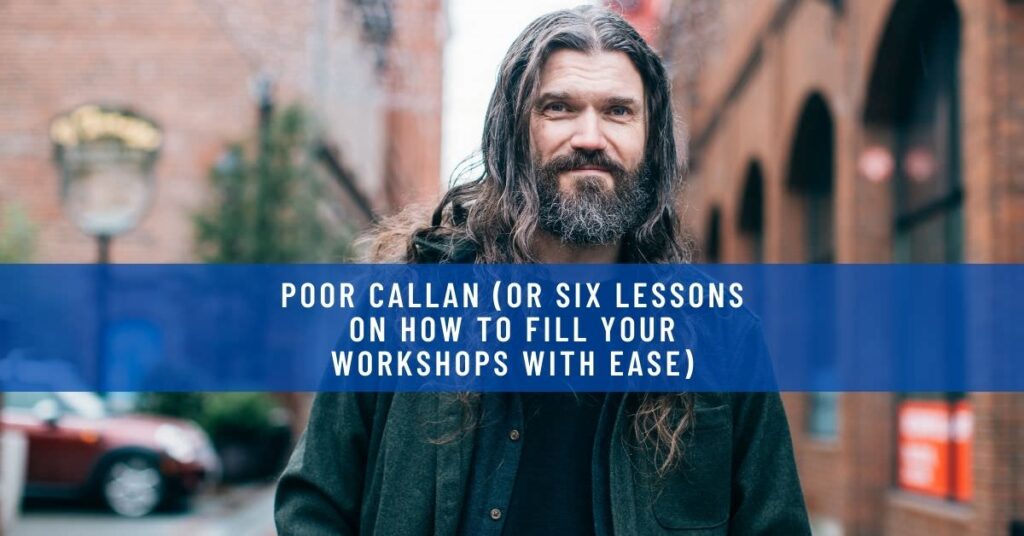
How to Sell Out Your Seminars

There’s a seminar I think you might want to go to. And, if you go, I want to give you a gift worth $100.

THE BACKSTORY: So, I just spent two days with 25 of the world’s leading small business marketing gurus. It was pretty great. More on that whole experience soon.

max simon1 How to Sell Out Your SeminarsBut, while I was there – I got to connect with Max Simon who was also participating. Max has got about to a decade of experience putting on high-quality live events, and it seems that he’s really nailed the formula for providing unparalleled content AND making six-figures per seminar. His dad is one of Deepak Chopra’s closest colleauges and Max grew up in the biz. He’s participated in and helped organize over 200 live events.

After dinner tonite, Max and I recorded a quick sit to chat about his upcoming program called “Sold Out Seminar Secrets“. Click play and check it out.

Max has put up some really useful free videos about his program. Check them out.

The Six Fundamental Things I Learned From Max About Filling Seminars:

LESSON #1: Focus on the experience. There are so many seminars and workshops available. And there will be more and more every year. And, being real, many with the virtually identical content. So, focus on the ‘experience’ pieces. Who else will be there? What kind of food will be served? Are there any parties included? Morning yoga? What could make it so special? What makes it memorable? If you pick a cool and unusual venue this can help draw people. Don’t focus on the content alone.

LESSON #2: Go Narrow and Deep. The more broad you are about your topic base the harder the workshop will be to fill. A workshop called, “Empowerment for Everyone!” will get a much smaller response than, “Online Marketing for Massage Therapists”. Narrow your focus on who it’s for – this allows you to go deep into tailoring the event for that crowd. Most workshops are Broad and Shallow in their focus. But the wider you go with your topic base the fewer people will come – ironic but true. Focus is power here. Focus on a particular group experiencing a particular problem and promise a particular result.

LESSON #3: Something They Can Finish. Build the workshop around a central result. Some promise of something they will actually accomplish by the end of the event. This will keep your event from just being a data dump. People are no longer satisfied with ‘more information’. They want results. So pick a particular result and then help them achieve that by the time the workshop finishes. Don’t just give them ideas. Give them time to integrate and work with those ideas during the workshop. For example, if the workshop was about how to lose weight – by the end of it they would have created a customized plan, phoned people to build a support team, booked their times with a personal trainer etc. If the result was about financial management – that they would bring their laptops and actually create a spreadsheet of their finances there and a plan for the next 12 months on exactly what they can do.

LESSON #4: Price higher. The lower the price – the less people will come. They’ll assume it’s not valuable. Narrow & deep + higher price + promised result = “Ooooh. This looks good!”

LESSON #5: Do it for them. If your workshop is about helping people describe what they do – give them a bunch of written examples. Give them cookie cutter ‘fill in the blanks’ templates they can use. The easier you can make it for them – the better.

LESSON#6: Give them value before they come. Max has got a lot of ideas on tactics to fill workshops – but you could do worse than doing a video launch. Meaning, offering people a series of three videos that give people not only a sense of the value of the event – but some useful tools they can use right away. A basic format to follow is: Video #1 is the Free Content. Video #2 are video testimonials from past participants. Video #3 is the video where you describe the event (focusing on the experience not just the content). Tell them about the content – but not in detail. More like Chapter Headings. Max has got some videos like this up – check them out.

This is really just the start. Max gave us a 45 minute download on his seminar at the workshop which is absolutely going to improve the way I promote my own workshops. I’m super grateful.

Check out Max’s free Sold Out Seminar Secrets videos. And consider going to his workshop – I think you’ll be glad you did.

gift 300x285 How to Sell Out Your SeminarsMY GIFT TO YOU: If you go – let me know – because I’d like to give you $100 of my time (30 minutes) to help you integrate it – as my way of saying, ‘Thanks for trusting me.’

But I invite you to share – what ideas and strategies do YOU have on filling up workshops? Share them below!


If you’d like get cool posts like this in your inbox every few days CLICK HERE to subscribe to my blog and you’ll also get a free copy of my fancy new ebook “Marketing for Hippies” when it’s done.


How to Organize Sales Pages to Avoid Overwhelm – Mark Silver

markmug31 How to Organize Sales Pages to Avoid Overwhelm   Mark SilverMark Silver is my favourite person in the world of marketing these days. Brilliant man. So I was incredibly flattered when he featured me (something he tells me he rarely does) in a post about sales pages on websites.

To read the article – click here.


If you’d like get cool posts like this in your inbox every few days CLICK HERE to subscribe to my blog and you’ll also get a free copy of my fancy new ebook “Marketing for Hippies” when it’s done.


Free is a Dirty Word

By Corwin Hiebert, an entrepreneur from Vancouver, Canada, who specializes in strategic event design, marketing, and creative talent management. His company, Red Wagon Management, produces and hosts CREATIVEMIX – Vancouver’s Ideation Conference. You can follow Corwin at www.twitter.com/corwinhiebert

corwin hiebert Free is a Dirty WordI’m convinced that the most offensive word in the event business is “FREE”, specifically when it refers to free admission for an event. Unless you’re new to capitalism, I think you’d agree that the word “free,” more often than not, communicates a lack of value. Whether or not an event can handle a zero-dollar ticket is often beside the point. What is, in fact, being communicated when no monetary commitment is required for an event is that expectations should be low.

When someone registers or plans to attend an event that is free they automatically assign that activity the category of “maybe.” If they are not liable for not showing up then it’s no big deal in their eyes. But it’s a big deal for you, the event planner. Your event plan can be seriously impacted when attendance is such a variable.

Consider the poor success of a Facebook invitation. I haven’t seen any official statistics but, in my experience, it’s a miracle even if 1% of the confirmed attendees from a Facebook event actually show up. Sure, there are the exceptions, such as mass bike rides and water gun fights, but event promotion via social marketing tools invokes little to no commitment. And when the commitment level is low it is that much easier for someone to bail.

Discounts are dangerous too. I come across this one all the time. As an event planner you know that fear, that gut-wrenching feeling, of having empty seats and you’ll do anything to fill them. Too often, prices are hacked and slashed to get people in the room. If you discount remaining tickets, you’ve got a couple liabilities on your hands. First of all, you’ve just filled the room with people who have lowered expectations. These low-paying people can skew survey results, create a negative vibe in the room, and may not be the right people for the event. The second liability is that your pre-existing registrants will go berserk on you and demand refunds, thus lowering your overall revenue and negating the funds you just earned by bringing in the cheapies. It’s a trap. Don’t discount. Add value, don’t lower it.


Helpful Tip:
Offer deals to event registrants only. When trying to increase attendance, focus on the people who have already registered for your event. By providing a discount on additional passes, they’ll be motivated to bring their own friends.

By Corwin Hiebert. Be sure to read his event planning eBook, Eleven and a Half Ways to Help Make Your Next Event a Huge Success. The downloadable PDF is only $3 when you use the special promotional code eventbrite2. Purchases can be made at http://www.redwagonmanagement.com


If you’d like get cool posts like this in your inbox every few days CLICK HERE to subscribe to my blog and you’ll also get a free copy of my fancy new ebook “Marketing for Hippies” when it’s done.


Promote the Why

By Corwin Hiebert, an entrepreneur from Vancouver, Canada, who specializes in strategic event design, marketing, and creative talent management. His company, Red Wagon Management, produces and hosts CREATIVEMIX – Vancouver’s Ideation Conference. You can follow Corwin at www.twitter.com/corwinhiebert

corwin hiebert Promote the WhyIn the midst of all the planning, we event managers often have the difficult task of leading the marketing effort for our projects. Generating demand for an event is no simple task, but it’s even harder when we spin our wheels promoting the wrong thing. When advertising efforts focus on registration (and ticket sales), they are a liability rather than an asset to the marketing plan because they require the most difficult type of commitment from our target audience: a financial decision.

Event promotions that overly emphasize registration details (price, discounts, deadlines, special offers, etc.) are in fact eliciting the simplest reaction possible: one of dismissal. Instead of trying to appeal to a potential attendee’s pocketbook, we should focus on piquing their interest on an experience they can’t easily find elsewhere. When we message our event in such a way so as to build up their expectations, we can minimize the advertising noise and create more meaningful collateral. Content-rich e-mail blasts, blog posts, tweets, updates, posters, and press releases are far more successful than ones full of registration pitches. By planting in their minds an image or emotion of what they will do, who they will see, and what kinds of memories or benefits they’ll receive, we’re connecting people to the true value of the event, not the cost.

Marketing collateral shouldn’t be that different than from verbal promotion. Think of it this way: if I were in a massive auditorium, standing in front of my target audience, and had 10 seconds to convince people to attend my event, I would not say something as moronic as, “Hello people, our big event is just $25, plus tax of course. So would you please sign-up today?! It should be lots of fun and, if you register right now, we’ll give you the early-bird free drink special package.” Silly, I know! I’d speak to what makes my event special and why people should want to be there; I wouldn’t even bring up the price. Posters, e-mail campaigns, advertisements and the like are a waste of time and money if I spend too much space promoting registration.

It’s common for sales people to be trained to elicit the word “yes” three times from their prospects before asking them if they would like to buy. Event marketing should take on the same tactic. If we can show our target audience that our event will meet at least three of their felt needs, that the pricing is reasonable, and the registration process is simple, then I think collecting their money will become the easiest task in our event plan.

Here are some helpful tips for your next event marketing effort:

1. Smaller is better. Decrease your need for ticket sales; adjust your budget and event space and focus on critical mass.

2. Less is more. Ensure your collateral is simple and visually compelling. Don’t get into the details; that’s what your event website is for.

3. Push it to the side. When sending an e-mail campaign, use an HTML template that has a sidebar—highlight your registration links and details separately from your primary message. With the majority of your e-mail body focusing on building excitement, your invitation will be perceived as subtle yet well-connected to the value of the experience you’re offering.

4. Use testimonials. Promote positive feedback from attendees at a previous event. Make sure you list their names (and their companies if possible)—anonymous quotes are useless.

5. Feature faces. Use images from previous events showing people having a lot of fun (they should be close-ups of faces, not a documentation of the activity).

6. Build partnerships. Develop a small, loyal affiliate base from people or groups who benefit from a successful event. Highlight them, and their stories, instead of always talking about the event. Treat them well, and they’ll become ambassadors who are passionate and motivated to spread the word. Be a fan of theirs and they’ll return the love.

7. Add value, don’t discount. Consider removing early-bird rates or special offers—set the value of the event and stick to your guns. If you need to boost sales, add benefits and give attendees more for their money.

Primetime marketing space shouldn’t be gobbled up with the details about dollars and deadlines. Instead, put the effort into creating a meaningful call to action. Dial down the registration hype and beef up the “why” hype.

By Corwin Hiebert. Be sure to read his event planning eBook, Eleven and a Half Ways to Help Make Your Next Event a Huge Success. The downloadable PDF is only $3 when you use the special promotional code eventbrite2. Purchases can be made at http://www.redwagonmanagement.com


If you’d like get cool posts like this in your inbox every few days CLICK HERE to subscribe to my blog and you’ll also get a free copy of my fancy new ebook “Marketing for Hippies” when it’s done.